
Life Insurance Basics: Cost-Saving Strategies for Employers
- Sydney Little
- Jan 17
- 7 min read

Updated: Mar 17

Choosing the right life insurance options can feel daunting for Southeast-based non-profits and assisted living facilities aiming to balance meaningful benefits with budget constraints. Offering well-structured employee life insurance is more than a perk. It is a path to true financial security for both teams and their families. By focusing on core concepts of life insurance contracts and group coverage requirements, HR managers can clarify their obligations, avoid costly missteps, and deliver the protection their organizations need.
Table of Contents
Key Takeaways
Point | Details |
Life Insurance Basics | Life insurance is a contract providing financial security to families after the death of an income earner, helping to avert economic hardships. |
Types of Policies | Employers can offer term, whole, and universal life insurance, each with unique features and benefits for employees. |
Group Policy Benefits | Group life insurance allows for reduced rates, additional coverage options, and lower costs compared to individual plans, making it a cost-effective solution for employers. |
Compliance Importance | Employers must carefully navigate eligibility and reporting regulations to avoid penalties, ensuring compliance with IRS guidelines on life insurance benefits. |
Defining Life Insurance and Core Concepts
Life insurance represents a critical financial protection mechanism designed to provide financial security for employees and their families. At its most fundamental level, life insurance is a contract between an insurer and the policyholder where monetary benefits are guaranteed upon the death of the insured individual.
The core purpose of life insurance extends beyond simple monetary compensation. It functions as a strategic financial instrument that helps protect families and dependents from potential economic hardship following the loss of a primary income earner. Different policy types exist, including term life insurance (which provides coverage for a specific timeframe) and whole life insurance (offering lifelong protection with potential cash value accumulation).
Under current regulatory frameworks, life insurance contracts must meet specific actuarial and tax-related requirements to qualify for specific tax benefits. These regulations ensure that insurance products maintain financial integrity and provide meaningful protection for policyholders. Key considerations include demonstrating an insurable interest - meaning the policyholder must have a legitimate financial stake in the insured individual’s continued existence.
Pro tip: When designing life insurance benefits for your organization, consider consulting with a licensed insurance professional who can help tailor policies to your specific workforce demographics and budgetary constraints.
Types of Life Insurance for Employees
Employers have multiple life insurance options to provide comprehensive financial protection for their workforce. Group-term life insurance remains the most common employer-sponsored option, typically offering coverage up to $50,000 without generating taxable consequences for employees.
The primary types of life insurance available through employer programs include term life insurance, whole life insurance, and universal life insurance. Term life insurance provides coverage for a specific period and generally offers the most affordable premiums. Whole life insurance offers lifelong protection with a cash value component that can accumulate over time, while universal life insurance provides more flexible premium structures and potential investment opportunities.
Group life insurance policies often cover employees at significantly reduced rates compared to individual plans. These policies can be structured to include additional benefits such as dependent coverage, optional supplemental policies, and varying levels of financial protection. Employers typically negotiate these group rates, which can result in substantial cost savings for both the organization and its employees.
Pro tip: When designing your employee life insurance benefits, conduct a comprehensive workforce demographic analysis to select policy types that provide the most appropriate and cost-effective coverage for your specific organizational needs.
Here’s a concise comparison of employee life insurance policy types available through workplace programs:
Policy Type | Coverage Duration | Cash Value Component | Premium Flexibility |
Term Life | Fixed period (e.g., 10-30 years) | None | Low, fixed premiums |
Whole Life | Lifetime | Builds guaranteed value | Higher, fixed premiums |
Universal Life | Lifetime | Variable value and growth | Flexible premium options |
This table summarizes how coverage and features differ among major policy types.
How Group Life Insurance Policies Work
Group life insurance policies operate through a comprehensive mechanism designed to provide financial protection for employees. These policies typically cover a group of employees under a single contract negotiated by the employer, with the first $50,000 of coverage generally remaining tax-free for participants.
The structure of group life insurance involves several key components. Employers can choose to fully fund the policy, split costs with employees, or offer optional supplemental coverage. Basic coverage is often calculated as a multiple of an employee’s annual salary, with standard limits typically ranging between one to three times the employee’s annual compensation. Employees may have the opportunity to purchase additional coverage during open enrollment periods, which might require Evidence of Insurability for higher coverage amounts.

Institutional group life insurance programs provide flexible enrollment options that allow employees to customize their coverage. Most policies include additional benefits such as Accidental Death and Dismemberment (AD&D) coverage, which provides extra financial protection beyond standard life insurance. The premium costs are typically more affordable compared to individual policies due to the group rate negotiation.
Pro tip: Review your group life insurance policy details annually and reassess coverage needs during major life events to ensure your employees maintain appropriate financial protection.
Eligibility, Enrollment, and Compliance Requirements
Group life insurance eligibility involves complex regulatory requirements that employers must carefully navigate. Typically, employees must be actively working on the enrollment date to qualify for coverage, with specific rules governing different employee classifications and uniform premium structures.
Employment status plays a critical role in determining life insurance eligibility. Full-time employees are usually automatically enrolled, while part-time and contract workers may have different coverage options. Organizations must establish clear, consistent enrollment criteria that comply with federal guidelines. This often includes defining employee classes, setting coverage limits, and establishing uniform pricing within each classification group.
Federal employee insurance programs provide a comprehensive framework for enrollment, which many private sector organizations use as a benchmark. Employees generally have specific enrollment windows, including initial enrollment periods and special life event windows. Key compliance requirements include accurately reporting taxable benefits, maintaining proper documentation, and ensuring that coverage meets Internal Revenue Service regulations regarding imputed income and tax withholding.
Pro tip: Develop a comprehensive checklist that tracks employee eligibility, enrollment periods, and compliance documentation to streamline your group life insurance management process.
Cost Factors and Common Employer Mistakes
Group life insurance cost calculation involves multiple complex factors that employers must carefully navigate. The primary cost determinants include employee age bands, total coverage amounts, and the organization’s contribution structure. Premiums can vary significantly based on workforce demographics, with older employee populations typically generating higher insurance expenses.
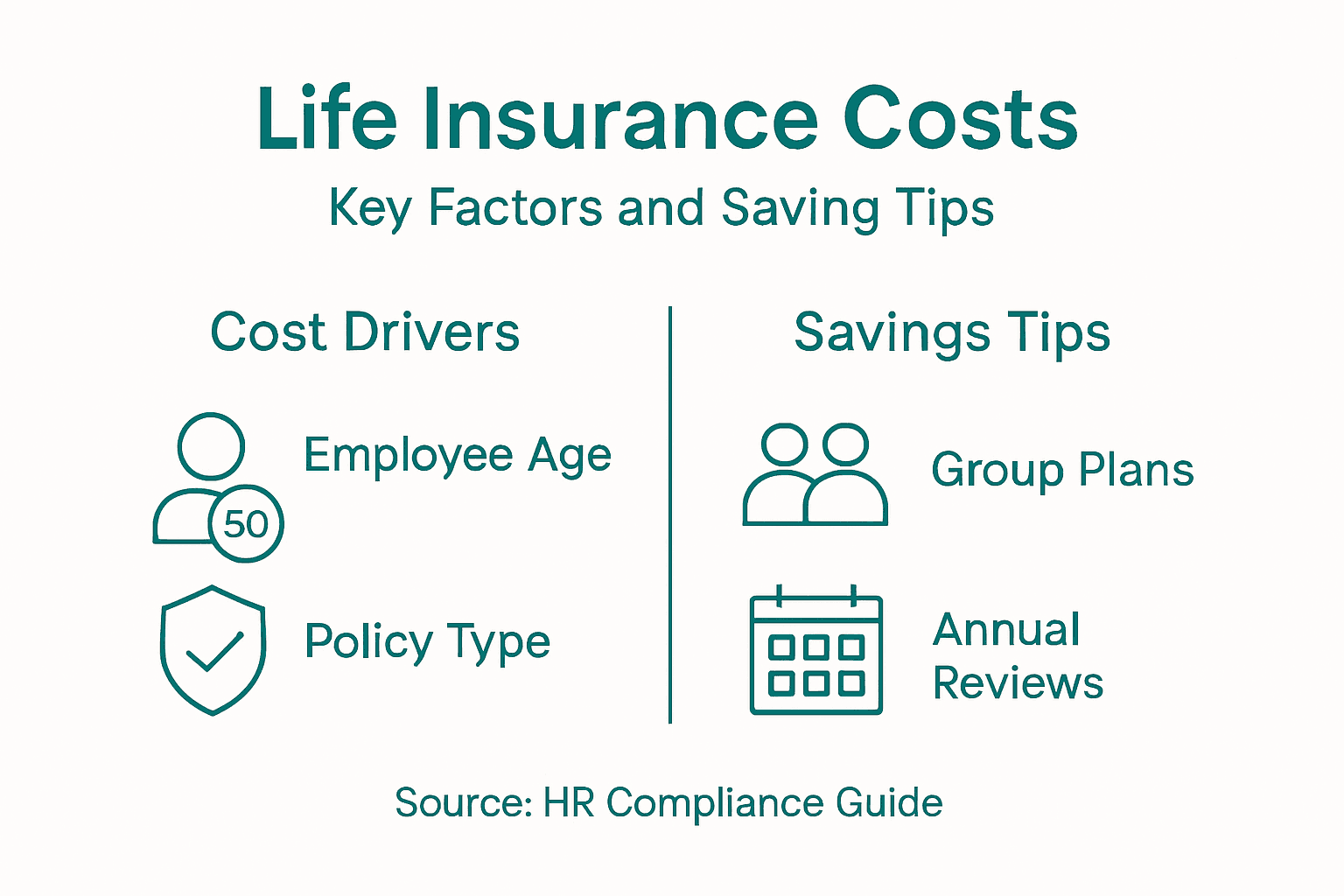
Employers frequently encounter significant compliance challenges when managing life insurance programs. Common mistakes include misclassifying employee coverage levels, incorrectly calculating imputed income, and failing to properly report taxable benefits on employee wage statements. Age-based premium calculations require precise tracking, as even slight miscalculations can result in substantial financial penalties and potential regulatory violations.
Imputed income calculations present particularly challenging compliance issues for many organizations. The Internal Revenue Service provides specific premium tables that employers must use to determine taxable income for life insurance benefits exceeding $50,000. Organizations must meticulously track coverage amounts, employee age classifications, and potential tax implications to avoid inadvertent regulatory violations.
Pro tip: Implement an annual audit process that reviews life insurance benefit calculations, ensuring accurate reporting and minimizing potential compliance risks.
Here are common cost factors and risks employers should monitor when managing group life insurance:
Factor | Impact on Cost | Compliance Risk | Prevention Tip |
Employee Age Bands | Older staff cost more | Misclassification errors | Update staff ages annually |
Coverage Amounts | Higher limits cost more | Imputed income miscalculations | Track individual coverage changes |
Contribution Structure | Employer vs. shared funding | Under- or over-reporting benefits | Review funding agreements yearly |
Monitoring these factors helps ensure accurate reporting and legal compliance.
Maximize Savings and Compliance with Expert Employee Life Insurance Solutions
Managing group life insurance can quickly become overwhelming as you balance employee eligibility, imputed income calculations, and premium cost factors like age bands and coverage amounts. This article highlights how critical it is to stay precise and compliant to avoid costly mistakes while providing the protection your employees deserve. If you want to reduce these risks and uncover cost-saving strategies that perfectly align with your workforce demographics, expert guidance is essential.

Take control of your employee life insurance program today by partnering with specialized benefits brokers who focus on cost reduction and compliance. Visit our booking page to schedule a personalized consultation. Discover how our tailored solutions can simplify group life insurance policy management while optimizing your employer contributions and minimizing tax risks. Don’t leave savings on the table—act now to secure financial peace of mind for your organization and employees.
Frequently Asked Questions
What is life insurance and why is it important for employees?
Life insurance is a contract between an insurer and a policyholder that provides financial protection to beneficiaries upon the death of the insured. It is important for employees as it helps secure their family’s financial stability in case of the loss of the primary income earner.
What are the different types of life insurance policies available for employees?
The main types of life insurance policies for employees are term life insurance, whole life insurance, and universal life insurance. Term life offers coverage for a fixed period, whole life provides lifelong protection with cash value accumulation, and universal life offers flexible premiums and investment opportunities.
How do group life insurance policies work for employees?
Group life insurance policies cover multiple employees under a single contract negotiated by the employer. These policies generally provide tax-free coverage up to $50,000 and include options for additional coverage and benefits like Accidental Death and Dismemberment (AD&D).
What are common mistakes employers make when managing life insurance benefits?
Common mistakes include misclassifying employee coverage levels, incorrectly calculating imputed income for taxable benefits, and failing to report benefits accurately. Employers should regularly audit their policies and ensure compliance with federal regulations to avoid penalties.
Recommended



Comments