
What Is a SIMRP? Boosting Savings for Senior Care

Updated: Mar 17

Finding cost-effective ways to support staff health at assisted living facilities can be challenging, especially when balancing budgets and compliance rules. In the Southeast United States, many benefits coordinators are exploring a Self-Insured Medical Reimbursement Plan as a practical alternative to traditional insurance. Understanding SIMRPs helps decision-makers clarify their financial advantages, tackle misconceptions, and design plans that improve both employee retention and overall satisfaction.
Table of Contents
Key Takeaways
Point | Details |
Flexibility of SIMRPs | Self-Insured Medical Reimbursement Plans allow tailored healthcare solutions, enabling organizations to design customized benefits that meet specific needs. |
Compliance is Crucial | Strict adherence to IRS Section 105 regulations is necessary to maintain tax-exempt status and avoid penalties. |
Cost Management Opportunities | SIMRPs can lead to substantial cost savings by eliminating traditional insurance premiums and leveraging tax-advantaged reimbursements. |
Risk Mitigation Strategies | Employing stop-loss insurance and third-party administration can help manage financial exposure and compliance risks. |
Defining a SIMRP and Common Misconceptions
A Self-Insured Medical Reimbursement Plan (SIMRP) represents a strategic alternative to traditional health insurance that allows employers to take more direct control of employee medical expense coverage. Governed by specific IRS regulations, these plans enable organizations to reimburse employees for qualified medical expenses without routing claims through standard insurance carriers.
Under IRS Section 105, SIMRPs provide unique financial advantages by allowing employers to directly manage healthcare expenditures. These plans shift healthcare cost risk onto the organization while offering potential tax benefits. Key characteristics include:
Direct reimbursement of employee medical expenses
Tax-advantaged compensation structure
Flexibility in plan design
Potential for lower overall healthcare spending
Common misconceptions about SIMRPs often stem from misunderstanding their regulatory requirements. Many employers incorrectly assume these plans operate like traditional insurance, when in fact they demand strict compliance with non-discrimination rules and precise documentation. The plan must be a separate written document that explicitly outlines reimbursement parameters, ensuring fair treatment across employee compensation levels.
Here’s a quick comparison of SIMRPs and traditional group health insurance:
Aspect | SIMRP | Traditional Insurance |
Cost Predictability | Varies with claims | Fixed premiums |
Plan Flexibility | Highly customizable | Limited by insurer |
Administrative Burden | Employer must manage compliance | Insurer handles administration |
Tax Advantages | Tax-advantaged reimbursements | May include tax benefits |
Risk Exposure | Employer bears direct risk | Insurer absorbs large claims |
.
How SIMRP Works for Assisted Living Facilities
Assisted living operators face a unique mix of challenges: high turnover, aging workforces, and narrow operating margins. SIMRPs can help when used to stabilize benefits costs without increasing premiums.
In practice, SIMRPs allow facilities to:
Reimburse routine and preventive care directly
Reduce low-dollar insurance claims
Protect future renewals by keeping utilization off the carrier’s books
Offer tangible benefits to frontline staff without adding fixed costs
Common reimbursable categories include:
Preventive visits and screenings
Prescription copays
Diagnostic testing
Telehealth and second-opinion services
What leaders often miss: The real value is not generosity, rather claims behavior control. Every dollar reimbursed outside the insurance plan is one less data point influencing renewal trend.
Pro tip: Conduct a thorough analysis of your facility’s specific healthcare utilization patterns before implementing a SIMRP to ensure the most cost-effective and employee-friendly design.
Legal Compliance: Section 105 and IRS Rules
Section 105 of the Internal Revenue Code provides the critical legal framework governing Self-Insured Medical Reimbursement Plans (SIMRPs), establishing essential guidelines for tax treatment and employee benefits. Specific IRS regulations mandate strict compliance requirements that organizations must carefully navigate to maintain tax-exempt status.
Key compliance elements include:
Nondiscrimination rules for benefit distribution
Precise documentation of medical expense reimbursements
Clear reporting of contributions and expenses
Equitable treatment across employee compensation levels
Employer documentation requirements are particularly stringent. Organizations must maintain comprehensive records demonstrating that SIMRP plans do not disproportionately benefit highly compensated employees. The IRS scrutinizes these plans to ensure they represent legitimate healthcare benefit strategies rather than tax avoidance mechanisms.
The regulatory landscape requires assisted living facilities to implement multiple safeguards:
This summary highlights key compliance safeguards needed for SIMRPs:
Safeguard | Purpose | Impact on Organization |
Nondiscrimination Policy | Ensures fair benefit distribution | Promotes equitable treatment |
Detailed Documentation | Supports IRS compliance | Reduces audit risk |
Third-Party Oversight | Provides independent monitoring | Enhances plan credibility and control |
Consistent Application | Maintains uniform rules | Minimizes regulatory infractions |
Develop transparent reimbursement policies
Establish clear eligibility criteria
Create consistent application of benefit rules
Maintain audit-ready documentation
Utilize third-party administration for independent oversight
Pro tip: Engage a tax professional specializing in Section 105 compliance to conduct an annual review of your SIMRP documentation and ensure ongoing regulatory adherence.
Cost Savings, Risks, and Common Pitfalls
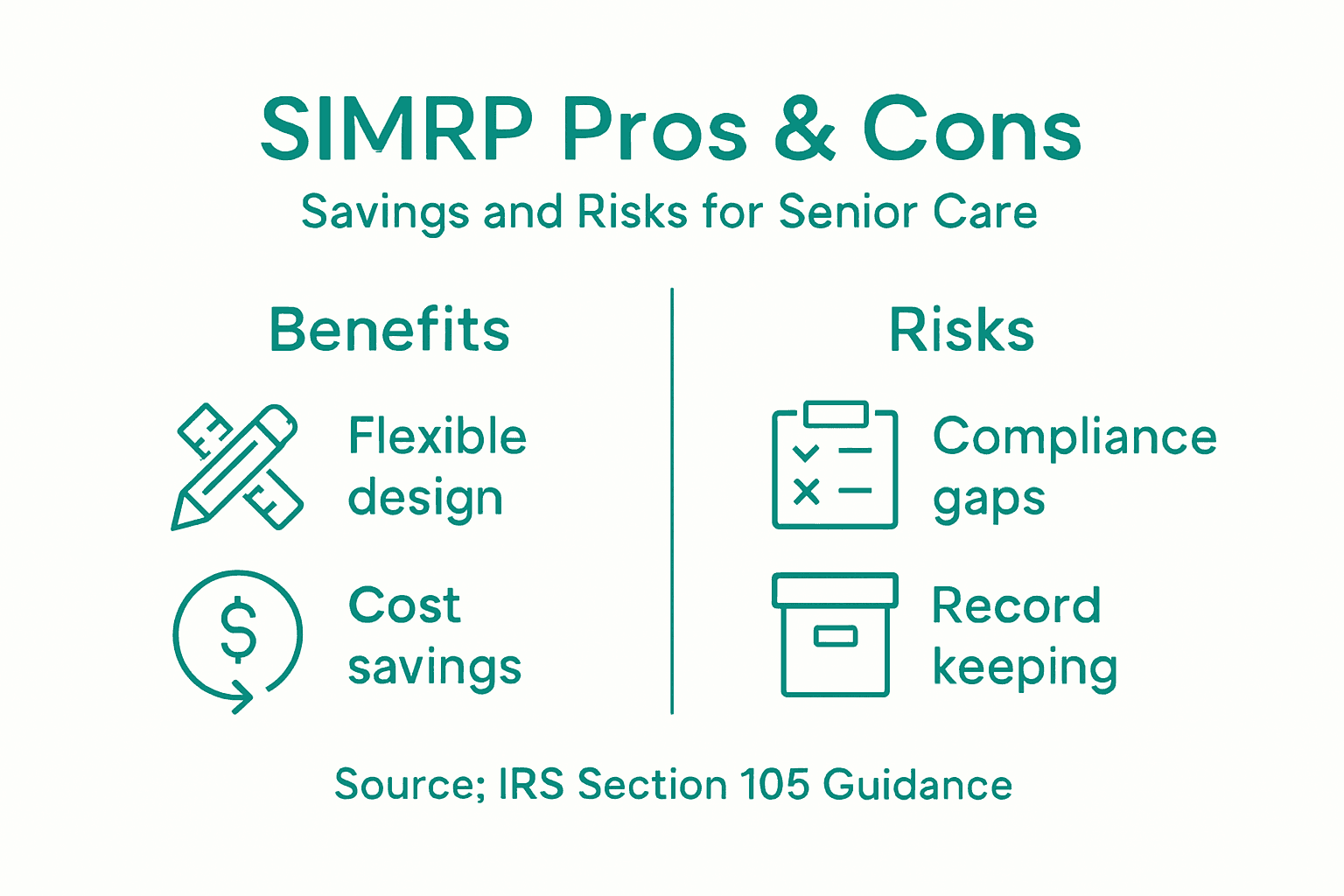
Self-Insured Medical Reimbursement Plans (SIMRPs) offer significant potential for cost reduction, but they also come with complex financial and regulatory challenges. Organizations must carefully evaluate potential risks to ensure successful implementation and sustainable healthcare benefits.
Primary cost savings mechanisms include:
Eliminating traditional insurance premium structures
Leveraging tax-free expense reimbursement
Customizing benefit designs to organizational needs
Reducing administrative overhead
Common pitfalls require strategic management, particularly around compliance and financial exposure. Potential risks encompass:
Unexpected large medical claims
Inadequate reserve funding
Non-compliance with IRS discrimination rules
Complex administrative requirements
Potential financial liability for catastrophic expenses
Mitigating these risks demands proactive strategies such as:
Implementing comprehensive stop-loss insurance
Conducting regular plan design reviews
Maintaining detailed documentation
Engaging specialized third-party administrators
Developing robust compliance monitoring systems
Pro tip: Conduct a thorough risk assessment and financial modeling before implementing a SIMRP to understand your organization’s specific risk tolerance and potential exposure.
Take Control of Your Senior Care Costs with a Tailored SIMRP Solution
Managing healthcare expenses in senior care facilities can feel overwhelming as you navigate complex IRS Section 105 compliance and aim to reduce costly insurance premiums. Many assisted living providers face the challenge of balancing financial risk, employee engagement, and strict documentation requirements. Self-Insured Medical Reimbursement Plans offer powerful flexibility and tax advantages but demand expert guidance to avoid common pitfalls such as nondiscrimination violations and unexpected high claims.
You do not have to face these challenges alone. Our team specializes in strategies designed to maximize savings while ensuring full regulatory compliance. By customizing SIMRP designs aligned with your organization’s unique needs, you gain control over benefit reimbursements and reduce administrative burdens.
Discover tailored options for Self-Insured Medical Reimbursement Plans with confidence and secure financial relief for your organization today.
Frequently Asked Questions
What is a Self-Insured Medical Reimbursement Plan (SIMRP)?
A SIMRP is a plan that allows employers to reimburse employees for qualified medical expenses directly, providing more control over healthcare expenditures compared to traditional health insurance.
How can a SIMRP help senior care facilities save on healthcare costs?
SIMRPs can reduce overall healthcare spending by eliminating traditional insurance premium structures, providing tax-advantaged reimbursements, and offering flexibility in plan design tailored to the specific needs of senior care facilities.
What are the compliance requirements for a SIMRP?
Compliance requires strict adherence to IRS regulations, including nondiscrimination rules, precise documentation of medical expense reimbursements, and equitable treatment across employee compensation levels to maintain tax-exempt status.
What are the potential risks associated with a SIMRP?
Potential risks include unexpected large medical claims, inadequate reserve funding, non-compliance with IRS regulations, and complex administrative requirements that could lead to financial liabilities.
Recommended



Comments